About the Journal
Focus and Scope
Peer-reviewed open access scientific edition that publishes new scientific results in the field of computer science, system analysis and management of complex systems, based on the application of modern mathematical methods and advanced information technology. Edition publishes works related to artificial intelligence, big data analysis and processing, modern methods of high-performance computing in distributed decision support systems, methods of mathematical and computer modeling.
Review Procedure
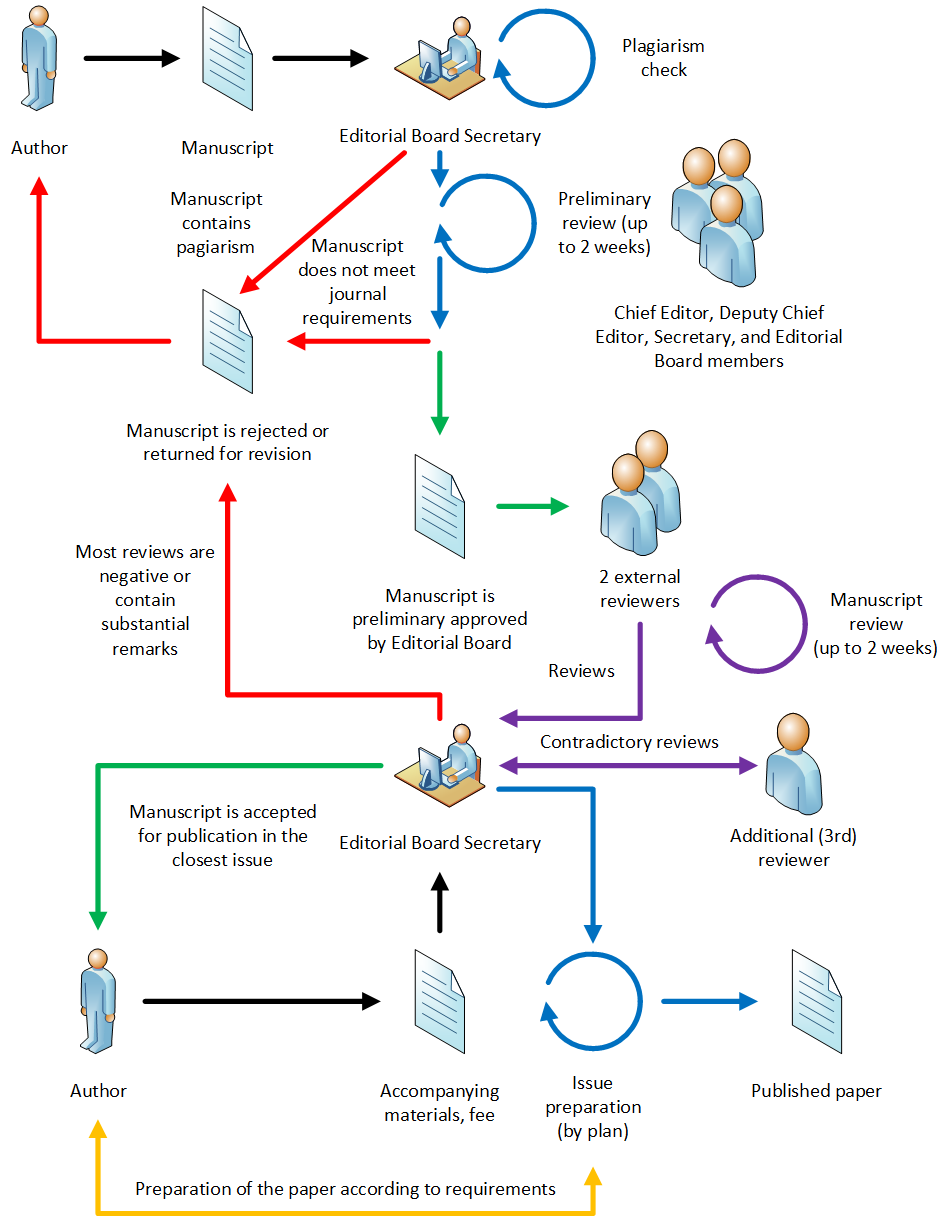
Materials submitted for publication must undergo internal selection by members of the editorial board in accordance with the areas of their scientific work.
Review type and reviewer selection criteria. The edition uses double-blind peer review: the identity of both the author and the reviewer remains hidden. Confidentiality is ensured by the editorial board headed by the editor-in-chief at all stages.
Reviewing (double-blind) of materials submitted for publication is carried out by two (three in the case of conflicting reviews) external scientists (not members of the editorial board) who have a scientific degree PhD (candidate of sciences) and conduct research in a specialty that corresponds to the topic of the material submitted for publication, and are authors (co-authors) of a total of at least three publications in scientific publications included in category "A" and/or category "B" of the List of Scientific Professional Publications of Ukraine, and/or in foreign publications indexed in the Web of Science Core Collection and/or Scopus databases in the relevant specialty, published over the last five years. Reviewers must not have a conflict of interest with the authors and cannot be residents of aggressor or occupying states.
Review timelines. The total time for reviewing submitted materials for publication can be up to 4 weeks. However, the total time from submission to publication can be up to 6 weeks (including up to 4 weeks for reviewing materials and up to 2 weeks for preparing them for publication). If an additional (third) reviewer is involved, this period may be extended by up to 2 weeks.
- Preliminary review of the manuscript (up to 2 weeks):
- Initial check. Verification of compliance with the publication's scope and requirements.
- Plagiarism check. If plagiarism exceeds 20%, the manuscript is rejected; if it is between 10–20%, it is returned for revision.
- Appointment of reviewers. Assignment of 2 external reviewers.
- Peer review (up to 2 weeks). Independent expert evaluation, with the possibility of involving a 3rd reviewer in case of conflicting feedback (this stage may be extended by up to an additional 2 weeks).
- Editorial board decision. Accepted / requires revision / rejected.
- Acceptance and preparation for publication (in the case of a positive decision).
Documentation and decision-making form. When selecting materials submitted for publication, are taken into account:
- compliance with the topic of the publication and the cluster "Information technologies and electronics";
- the relevance of the scientific problem;
- originality, scientific novelty and practical value of the research;
- the validity of the methods and the correctness of the calculations;
- the reliability and reproducibility of the results;
- the quality of the presentation of the work (scientific level and style of presentation of the material, article structure, grammar);
- the completeness of the list of sources of information and the validity of the available references to them;
- compliance with the requirements of academic integrity.
The conclusion on the acceptance or rejection of the article, including possible comments from the reviewer for finalizing the manuscript, is reflected in the prepared review form.
Confidentiality. Reviewers are required to maintain the confidentiality of the manuscript. Use of unfinished manuscripts for personal purposes without the consent of the authors is prohibited.
If there are any comments, articles may be returned to the authors for revision or rejected.
The editorial board does not allow for publication of articles that contain signs of plagiarism, self-plagiarism, and/or other violations of academic integrity (falsification of research results, submission of previously published materials, etc.). The StrikePlagiarism service is used to check submitted materials (until September 2024, the Unicheck service was used to check submitted materials).
Publication Frequency
The journal is published 3 times a year (until 2026, it was published 2 times a year).
Indicative publication schedule:
- Submission deadline: by March 15; publication: by April 30;
- Submission deadline: by September 15; publication: by October 30;
- Submission deadline: by November 15; publication: by December 31.
Articles accepted for publication but not included in the current issue due to volume limitations or delays in revision based on reviewers comments are carried over to the next issue, unless withdrawn by the authors.
Open Access Policy
This Journal is practicing a policy of immediate open access to published content, supporting the principles of free distribution of scientific information and global exchange of knowledge for the general social progress.
Open Data Policy and FAIR Principles
The publication encourages authors to make the research data supporting their results available in open repositories (Zenodo, Figshare, Dryad, OSF, etc.) or to provide justified access restrictions. Data must comply with the FAIR principles (Findable; Accessible; Interoperable; Reusable).
Authors must ensure the availability of basic metadata, the use of commonly accepted formats, and, where possible, persistent identifiers (e.g., DOI). In cases of restricted access, the conditions for obtaining the data must be clearly stated.
Archiving and Long-term Storage
Each article is assigned a unique DOI with the publisher prefix 10.20998. This provides:
- stable and immutable referencing;
- depositing full metadata in CrossRef;
- tracking all versions of the manuscript.
The publication date indicated on the website and in the article file fully corresponds to the date registered in the DOI metadata.
To ensure long-term access and the preservation of scholarly materials, articles are additionally deposited in:
This guarantees archival backup, open access, and the continued availability of publications regardless of any changes to the journal's technical infrastructure.
Sponsors
The Journal is funded by the authors’ own funds.
Journal History
Since 1961, the KhPI has been publishing a collection of scientific works "Bulletin of the Kharkiv Polytechnic Institute". According to the rector's order No. 158-1 dated 07.05.2001 "On organizing the publication of the Bulletin of the NTU "KhPI", the collection was renamed the Bulletin of the National Technical University "KhPI".
The history of the series begins in 1977. In this year the Bulletin of Kharkiv Polytechnic Institute "Applied Mechanics and Control Processes" was created at the Department of Automated Control Systems that was a part of the Engineering Physical Faculty. Bulletin was focused on the issues related to the design of complex technical and economical systems, application of economical and mathematical methods in planning and control, synthesis of automatic control systems, and other problems based on the computer science. In the end of 1977 the first issue was prepared. In the beginning of 1979 the first issue of the Bulletin was published. Therefore, this Journal is considered as founded in 1979.


Since then information technologies are progressing, as well as the Faculty and its Departments. In 1982 the new Department of Technical Cybernetics (now it's the Department of System Analysis and Information-Analytical Technologies) was founded. Since then the Bulletin is actually running at this department. The Bulletin got the new title "Technical Cybernetics and its Applications" as well.
Currently, the collection is published as the Bulletin of the National Technical University "Kharkiv Polytechnic Institute", series "System Analysis, Control and Information Technologies". The Editor-in-Chief of the series is the Director of the Educational and Scientific Institute of Computer Sciences and Information Technologies of NTU "KhPI", Doctor of Technical Sciences, Professor Mykhailo Dmytrovych Godlevskyi. The Executive Secretary of the editorial board - Professor of the Department of System Analysis and Information-Analytical Technologies of NTU "KhPI", Candidate of Technical Sciences Bezmenov Mykola Ivanovych - has held this position since 1977, since the creation of the Bulletin. The editorial board includes leading scientists of NTU "KhPI" and other organizations. Such, for example, are the Deputy Editor-in-Chief of the editorial board, Professor of the Department of System Analysis and Information-Analytical Technologies, Doctor of Technical Sciences, Professor, member of the National Committee for Automatic Control of NTU "KhPI" Kutsenko Oleksandr Serhiiovych; Professor of the Department of Computer Mathematics and Data Analysis of NTU "KhPI", Doctor of Technical Sciences, Professor, Laureate of the State Prize in the Field of Science and Technology Lyubchyk Leonid Mykhailovych; Professor of the Department of Computer Science and Software Engineering of the National Technical University of Ukraine "Kyiv Polytechnic Institute", Laureate of the V. M. Glushkov Prize of the NAS of Ukraine in the field of Computer Science, Laureate of the State Prize of Ukraine in the field of Science and Technology, Doctor of Technical Sciences, Professor Pavlov Oleksandr Anatoliyovych and others.